7 Chinese characters that are still drawings — the fastest win for day-one learners
Seven of the oldest characters in the script still look like what they draw. Learn these seven on day one and you have proof, in your own handwriting, that characters are not random.
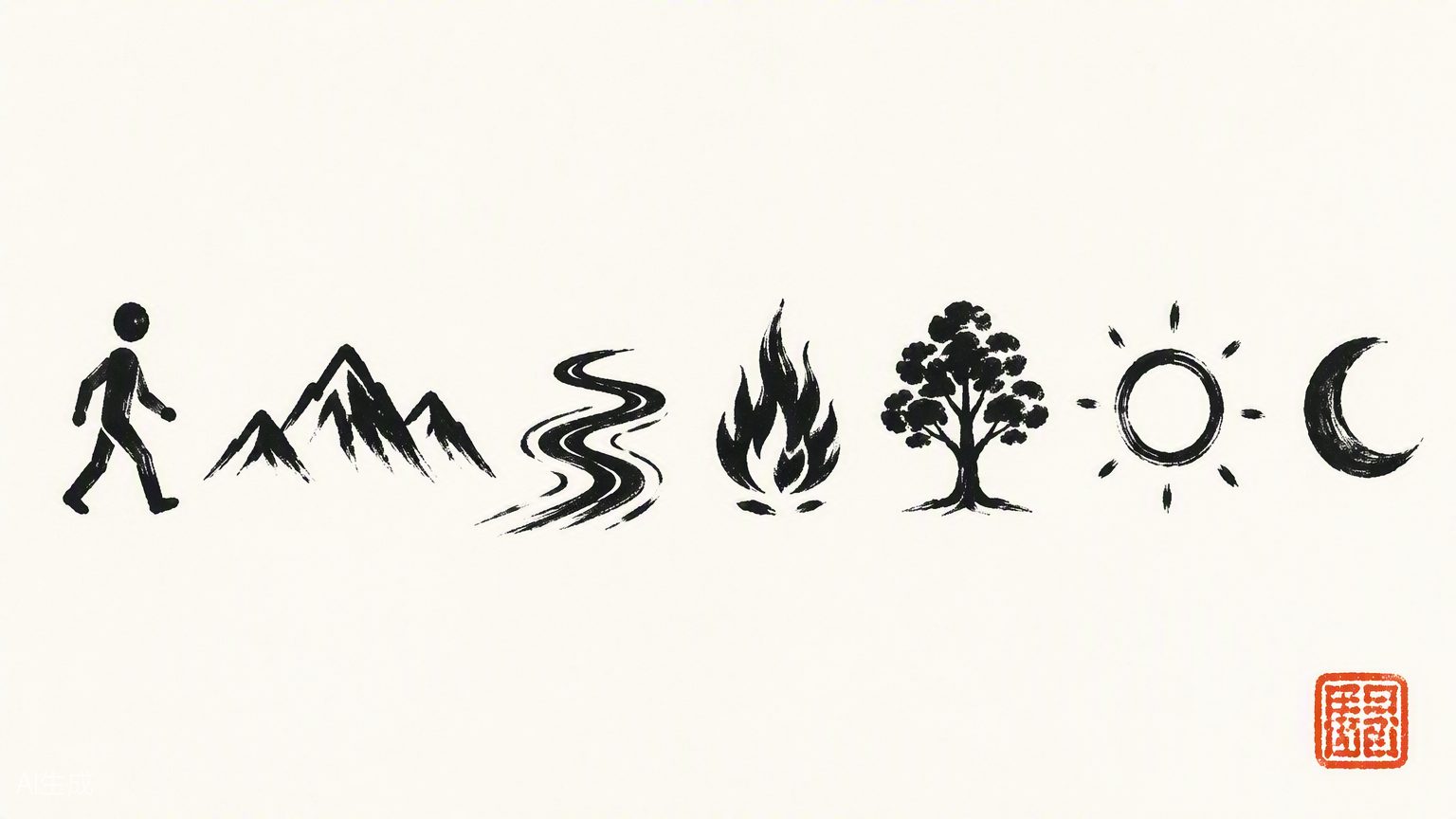
The first thing most beginners hear about Chinese characters is that there are thousands of them and you just have to memorize. The second thing they should hear — and usually don’t — is that some of the oldest characters are still drawings. Not metaphors. Drawings you can recognize without a teacher.
Here are seven you can learn today, in the time it takes to drink a coffee. Each one links to its full page, with stroke order and a printable practice sheet.
人 rén — a person
Two strokes, legs mid-stride, seen from the side. It is one of the oldest shapes in the script, and it still looks like what it draws. Once you see the walker, you will spot 人 hiding inside dozens of other characters — it is one of the most common building blocks in the language.
山 shān — a mountain
Three peaks, the middle one tallest. If you have ever seen a Chinese landscape painting, you have seen this character a hundred times without knowing it.
水 shuǐ — water
A stream with its current lines — a strong centre stroke with the water breaking around it. Watch for its squashed three-dot form 氵on the left of other characters: that little spray of dots means the word is probably about rivers, rain, sweat, tears, or wine.
火 huǒ — fire
A person-shaped flame with two sparks flying off the sides. Squashed on the left of another character (or as four dots 灬 at the bottom), it marks things that burn, cook, or glow.
木 mù — a tree
A trunk, two branches, two roots. One tree is 木; put two together and you get 林, a grove; three make 森, a forest. The script does this kind of arithmetic everywhere, and this is the friendliest first example of it.
日 rì — the sun
A box with a line through the middle — a drawing of the sun that got squared off over three thousand years of brush writing. It doubles as the word for “day”, and it sits inside characters about time and light.
月 yuè — the moon
The crescent moon, tipped upright. It also means “month”, which tells you something about how the calendar was kept. (Fair warning: on the left side of a character, an identical-looking shape usually means “flesh”, not “moon” — that is a story for another day.)
Why start here
Seven characters will not get you through a menu. That is not the point. The point is what happens in your head when you write 山 and it looks right: the script stops being a wall of random ink and becomes a system with a memory. Every character you learn after these seven gets easier, because you now believe they can be learned.
When you are ready to write them yourself, each page above has a free practice sheet — grid, fading guides, print as many as you like.
The characters from this article
Print all 7 →Keep reading